


As one of the largest and most diverse cities in the state, Aurora, Colorado, offers a unique blend of suburban comfort and urban accessibility.
Stretching across more than 160 square miles, Aurora has evolved into a dynamic hub for families, professionals, and first-time buyers looking for value near Denver without paying Denver prices.
But like any fast-growing suburb, Aurora comes with trade-offs. You’ll find more space, more affordability, and more cultural diversity—but also longer commutes and varying neighborhood conditions depending on where you land.
If you’re considering a move, it’s important to understand both sides of the equation. This guide breaks down the real pros and cons of living in Aurora, Colorado, helping you make a confident, well-informed decision based on your lifestyle, priorities, and budget.
What Are the Pros and Cons of Living in Aurora, Colorado
The main pros and cons of living in Aurora, Colorado, center on affordability versus convenience. Housing is more attainable than in Denver, offering better value and space, but trade-offs include longer commutes, car dependency, and varying safety across neighborhoods that require careful research before buying.
Evaluating the Aurora, Colorado Pros and Cons
The Affordability Advantage
When evaluating Aurora, Colorado, pros and cons, housing affordability stands out as the biggest win—especially for first-time buyers.
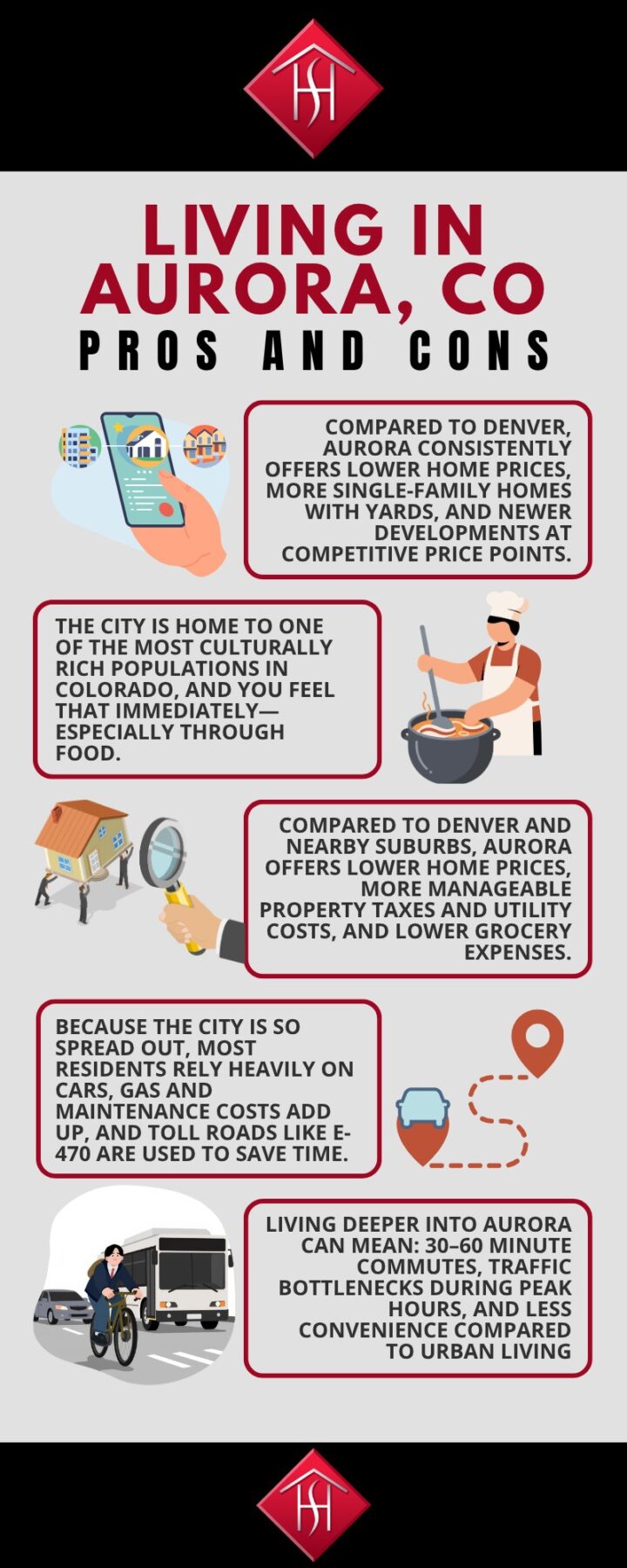
Compared to Denver, Aurora consistently offers:
- Lower median home prices
- More single-family homes with yards
- Newer developments at competitive price points
For buyers who feel priced out of Denver’s market, Aurora becomes a practical entry point into homeownership. You’re not just buying a home—you’re buying space, something that’s increasingly rare in urban Colorado.

That said, affordability can vary by area. Central Aurora tends to have older housing stock, while newer, master-planned communities in the southeast come at a premium—but still often below comparable Denver neighborhoods.
Diversity and Culture
One of Aurora’s most underrated strengths is its diversity. The city is home to one of the most culturally rich populations in Colorado, and you feel that immediately—especially through food.
From Ethiopian and Korean to Mexican and Vietnamese cuisine, Aurora arguably has the most authentic international dining scene in the entire state.
This diversity also translates into:
- Multicultural community events
- A welcoming environment for newcomers
- A broader mix of perspectives and lifestyles

For many residents, this is not just a “nice-to-have”—it’s one of the defining benefits of living here.
Understanding Safety in Aurora, CO Neighborhoods
Researching the Right Area
Because Aurora is so large and spread out, safety in Aurora, CO, neighborhoods can vary significantly.
- Some northern and more urbanized areas experience higher crime rates
- Central Aurora has a mix of older neighborhoods with varying conditions
- Southeast Aurora—especially master-planned communities like Southshore and Tallyn’s Reach—is widely considered safe, quiet, and family-friendly
This is why hyper-local research matters. Two neighborhoods just a few miles apart can feel completely different in terms of safety, schools, and overall livability.
Community Investment
The good news is that Aurora is actively investing in improving public safety. Local initiatives include:
- Expanded community policing programs
- Infrastructure upgrades
- Increased neighborhood engagement efforts
These improvements are helping elevate the overall quality of life across the city, though progress varies by area.
Analyzing the Aurora CO Cost of Living 2026
Housing and Utilities
The Aurora, CO cost of living 2026 remains one of the city’s strongest selling points.
Compared to Denver and nearby western suburbs like Golden, Aurora typically offers:
- Lower home prices
- More manageable property taxes
- Reasonable utility costs
- Slightly lower grocery expenses

For buyers looking to stretch their budget without leaving the metro area, Aurora provides real financial breathing room.
Transportation Costs
Here’s the trade-off: Aurora’s layout can increase transportation expenses.
Because the city is so spread out:
- Most residents rely heavily on cars
- Gas and maintenance costs add up
- Toll roads like E-470 are often used to save time
So while you may save on housing, you’ll likely spend more on getting around.
Comparing Living in Aurora vs Denver
The Suburban Space
When comparing living in Aurora vs Denver, space is the biggest differentiator.
In Aurora, you’ll find:
- Larger lot sizes
- Wider streets
- Less density
- Easy access to outdoor recreation like Cherry Creek State Park
It’s a more relaxed, suburban environment—ideal for families or anyone wanting room to breathe.

The Commute Trade-Off
The downside? Commute times.
If you work in:
- Downtown Denver
- The Denver Tech Center (DTC)
…you should expect longer drive times, especially during rush hour.
Living deeper into Aurora can mean:
- 30–60 minute commutes
- Traffic bottlenecks during peak hours
- Less convenience compared to urban living
This is one of the most important factors to weigh when considering your move.
Moving to Aurora, Colorado: Benefits and Drawbacks Table
| Lifestyle Factor | The Benefit (Pro) | The Drawback (Con) |
|---|---|---|
| Housing | Highly accessible entry prices | Older inventory in central areas |
| Space & Layout | Large yards, master-planned parks | Heavy suburban sprawl, car-dependent |
| Diversity | Incredible international dining scene | Lacks a centralized, walkable downtown |
| Location | Close to DIA and Cherry Creek Reservoir | Lengthy commutes to the mountains |
Key Takeaway
Successfully navigating the moving to Aurora Colorado benefits and drawbacks comes down to clarity. What matters more to you—space and affordability, or proximity and convenience?
Aurora offers real opportunities for buyers looking to maximize value, especially with the favorable Aurora CO cost of living 2026. But it also requires thoughtful decision-making—whether that’s researching safety in Aurora CO neighborhoods or understanding the daily reality of living in Aurora vs Denver.
When you fully understand the pros and cons of living in Aurora Colorado, you position yourself to make a smart, confident real estate investment that truly fits your lifestyle.
If you’re thinking about making a move and want expert guidance tailored to your goals, reach out anytime. Whether you’re weighing neighborhoods, comparing home values, or planning your next step, having the right strategy makes all the difference.
Call or text 702-506-5006 or email leahceller@gmail.com to start the conversation.
Frequently Asked Questions
Is moving to Aurora, Colorado, a good financial choice for first-time buyers?
Yes—Aurora is one of the most accessible entry points into the Denver metro housing market, offering better value and more space for your money.
How does the Aurora, CO cost of living 2026 compare to that of neighboring Centennial?
Aurora is generally more affordable than Centennial, particularly in terms of home prices and overall housing costs.
What are the best resources to check safety in Aurora, CO, neighborhoods before buying?
Use tools like local police reports, neighborhood crime maps, and speak with local real estate professionals who understand hyper-local trends.
Are there distinct tax advantages when living in Aurora vs. Denver?
While both cities are in the same state tax structure, Aurora often has slightly lower property tax rates and overall housing-related costs.
What are the most common pros and cons reported by new residents?
Pros: affordability, diversity, space.
Cons: commute times, car dependency, neighborhood variability.
Does the RTD light rail system make the commute from Aurora to Denver easier?
It helps in certain corridors, especially near major stations, but many areas still require driving to access transit.
How do the public schools in Aurora compare to the Cherry Creek School District?
Schools in the Cherry Creek School District (which serves parts of Aurora) are highly rated, while Aurora Public Schools vary depending on the neighborhood.